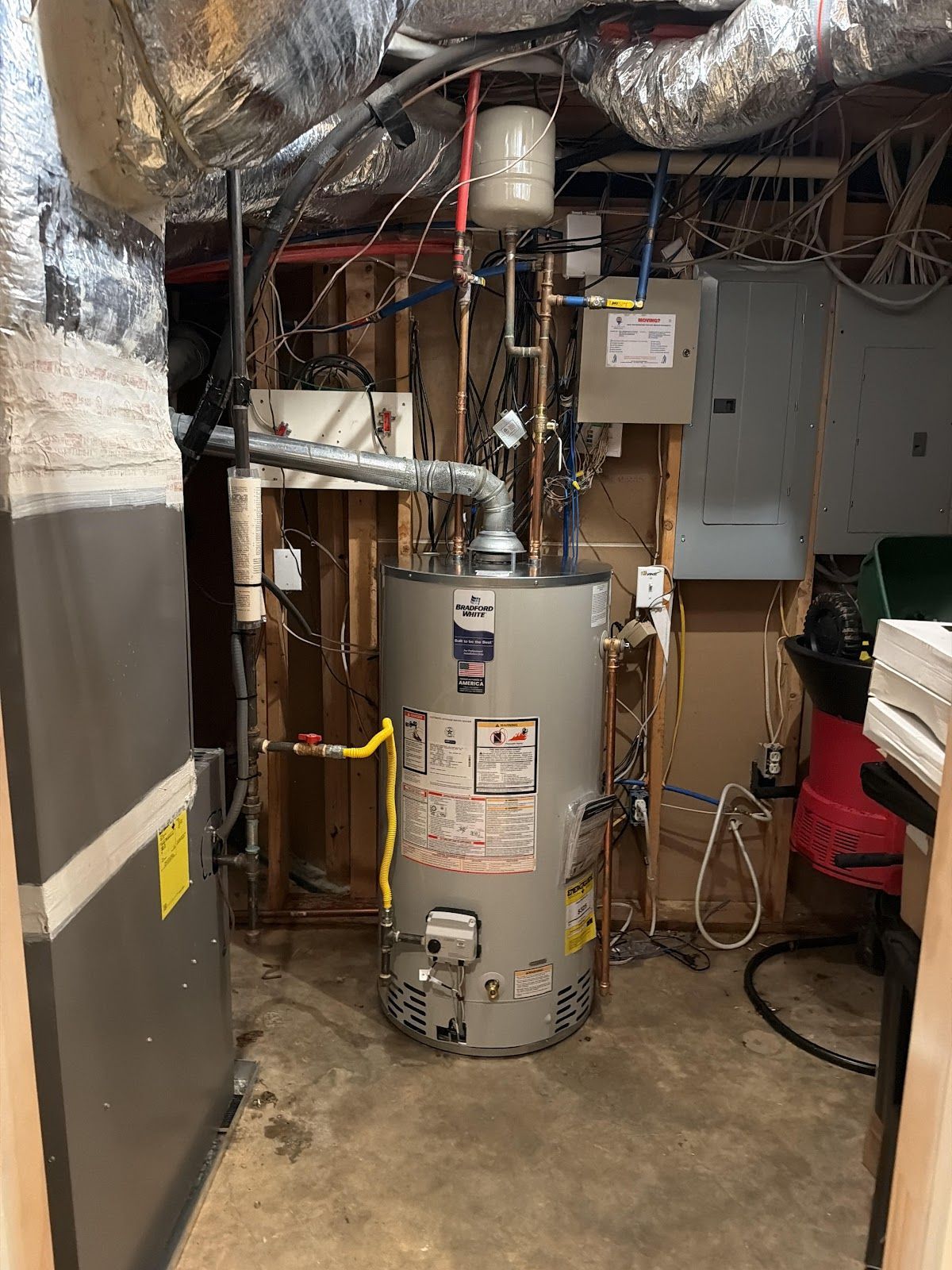

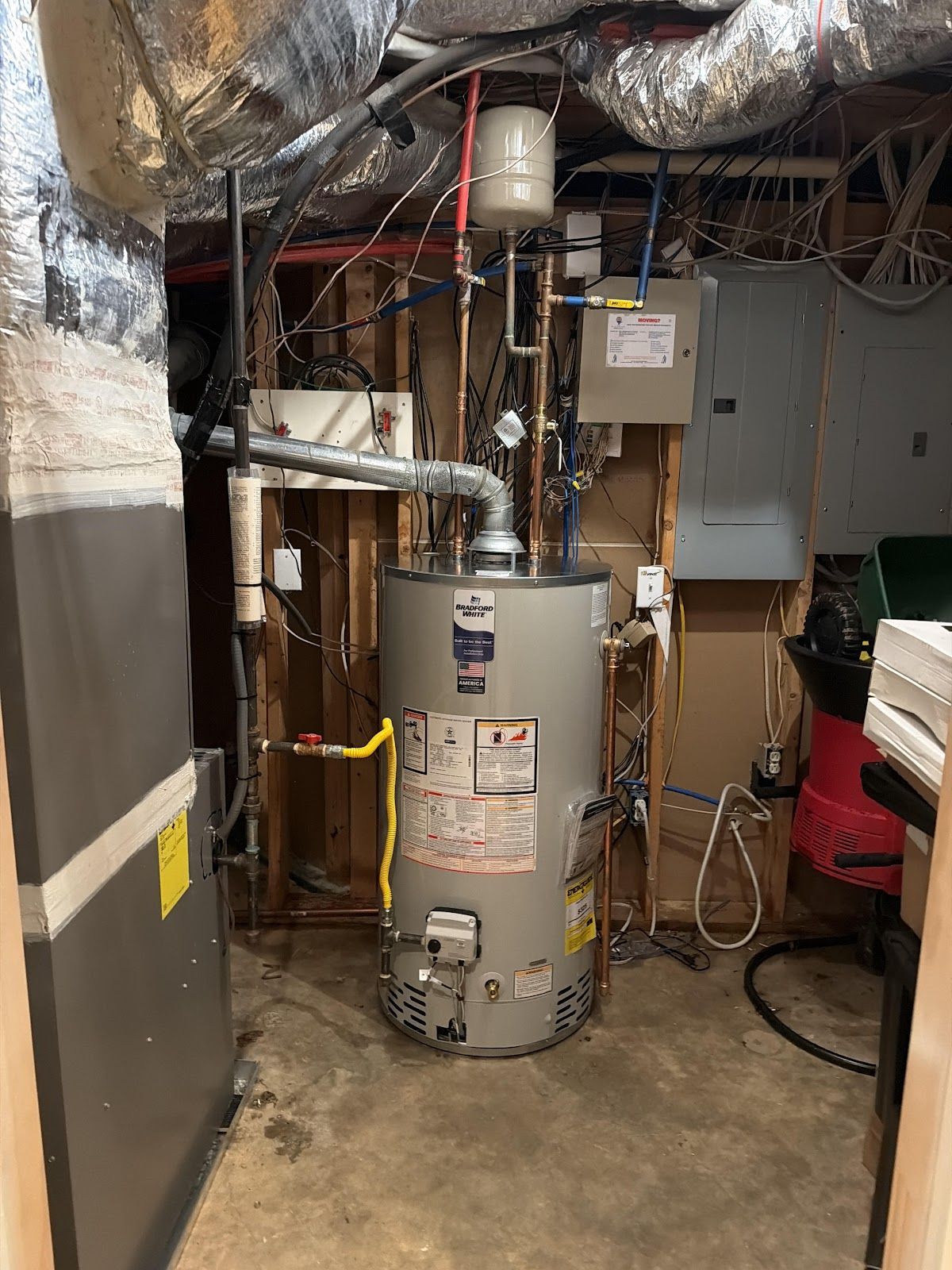
Water Heater Leaking? Find the Source Before You Panic
David Burkhead November 2, 2026

You walk into the garage and step in a puddle next to the water heater. Your first question is whether this is a small fix or a new unit.
Where the water is coming from answers most of that, usually within a few minutes. This guide shows you how to shut things down safely, find the source, and decide whether you need a simple part or full
water heater repair from Lanier Plumbing & Drain LLC.
TL;DR: What to do first if your water heater leaks
- Turn off the cold water going into the tank, then the power or gas. After that, find where the water is coming from.
- Leaks at the pipe connections, the relief valve, or the drain valve can usually be repaired. Water coming from the tank itself means it's time to replace the heater.
Your first 60 seconds: stop the water and the heat
Turn off the cold water supply to the tank, then cut the power or gas. That limits the damage and keeps you safe while you look around.
- Close the cold water valve on the pipe going into the top of the tank. Turn a round handle clockwise, or turn a lever a quarter turn.
- Shut off the energy source. For an electric heater, flip its breaker off. For a gas heater, turn the control knob to "Off" or "Pilot." If you smell gas, leave the house and call your gas utility or 911 from outside.
- Leave the tank alone. The water inside can scald you, so don't try to drain it yourself. If water is pouring out, get everyone clear and call us. A real plumber answers our phone 24/7 at (470) 740-7074.
- Move rugs, boxes, and anything else you care about away from the water.
Find where the water is coming from
Dry the floor and the outside of the tank, then wait 10 to 15 minutes. Wherever fresh water shows up first is your best clue.
| Where you see water | Likely cause | Usually means |
|---|---|---|
| Top of the tank, at the pipes | Loose or corroded fitting, or a worn supply line | Repair |
| Relief valve, or the pipe running down from it | Too much pressure or heat, or a worn valve | Repair the cause |
| Drain valve near the bottom | Valve not fully closed, or worn out | Repair |
| Under the tank, with nothing dripping from above | Tank has rusted through | Replace |
| Beads of water on a gas heater, mostly on cold mornings | Condensation | Usually nothing, but have it checked if it keeps happening |
| A puddle nearby, but the tank and pipes are dry | AC drain line, another pipe, or a slow floor drain | Depends on the source |
Water from under the tank needs a call the same day. The other sources can usually wait a day or two once the water is shut off.
Leaks at the top of the tank
Most leaks at the top come from the fittings, so the tank itself is usually fine. Water can run down the outside of the heater and pool at the base, which makes a small top leak look like a big problem.
Wipe each connection with a dry paper towel to find the wet one. The usual culprit is a loose nut, a corroded metal fitting where the pipe meets the tank (a dielectric union), or a flexible supply line that has worn out. These are usually quick repairs.
A dripping relief valve
A dripping relief valve usually means the tank is too hot or under too much pressure. Sometimes the valve itself has worn out.
This valve, called the T&P valve (temperature and pressure relief valve), opens to let off pressure before the tank becomes dangerous. Never plug or cap it to stop a drip.
Two causes come up most often. One is a thermostat set too high. The other happens when heated water expands and has nowhere to go, which pushes the pressure up. A small expansion tank on the water line gives that extra water somewhere to go.
Check your thermostat while you're there. The U.S. Consumer Product Safety Commission recommends setting home water heaters to 120°F, and its scald prevention guidance notes that 140°F water can cause burns in six seconds (CPSC, Avoiding Tap Water Scalds).
Leaks from the drain valve
A drip from the spigot near the bottom usually means the drain valve isn't fully closed or has worn out. Try turning the handle closed by hand first.
If it still drips, we can replace the valve without replacing the heater. Our vans are fully stocked, so most repairs are finished in one visit.
Water coming from the tank itself
If the fittings and valves are dry but water keeps showing up under the tank, the tank has most likely rusted through. A tank leak can't be repaired, so the heater needs to be replaced.
Steel tanks rust from the inside. A metal rod inside the tank (the anode rod) slowly wears away to protect the steel, and once it's used up, the tank starts to corrode. If your heater has also been rumbling or knocking, our guide on
why a water heater makes a knocking sound explains what those noises mean.
When we replace a heater, we haul the old one away and dispose of it responsibly.
How the age of your heater changes the call
Age is the tiebreaker when a leak could go either way. Fixing a valve on a young heater makes sense, while the same fix on an old tank may only buy a little time.
Find the age on the label on the side of the tank (the data plate). Many brands put the manufacture date inside the serial number, so check the manufacturer's website to learn how to read it.
According to the U.S. Department of Energy, storage tank water heaters last 10 to 15 years, and most tankless heaters last more than 20 years (DOE Energy Saver: Tankless or Demand-Type Water Heaters).
| Heater age | Leak at a fitting or valve | Leak from the tank |
|---|---|---|
| Under 6 years | Repair it, and check the warranty | Replace, but ask about the tank warranty first |
| 6 to 10 years | Repair it, and start planning ahead | Replace |
| Over 10 years | A repair may only buy time, so price a replacement too | Replace |
If replacement makes sense, you'll get a firm, written price before any work starts and a written workmanship warranty on our work. Financing is available if you need it.
Why a slow leak is worth fixing this week
A small leak gets expensive because of what the water reaches over time. A slow drip can soak into flooring, walls, or the ceiling below before anyone notices.
Insurance data shows what's at stake. Triple-I (the Insurance Information Institute) estimates that about one in 60 insured homes has a water damage or freezing claim each year, and those claims averaged $15,400 from 2019 to 2023, based on ISO/Verisk data (Triple-I, Facts + Statistics: Homeowners and renters insurance). Those figures include every type of water damage claim, so water heaters are only one part of the picture. Still, they show how fast loose water turns into a big bill.
What happens when we come out
We find the source, explain your options, and give you a firm, written price before any work starts. If you decide not to go ahead, the only charge is the diagnostic fee.
On a leak call, we'll:
- Confirm where the water is coming from, including nearby sources like the AC drain line.
- Test your home's water pressure and check whether you need an expansion tank.
- Check the heater's age and look for rust at the base.
- Walk you through repair and replacement prices so you can choose.
Every job is handled by our team, led by a Georgia Master Plumber (License #MP208625) with more than 43 years in the trade. We're fully insured, and we leave the job site clean. Calls placed before noon typically get same-day service. You can read more about
water heater replacement in Cumming and how we serve homes throughout Forsyth County and North Georgia.
Bottom line: find the source, then decide
A puddle by your water heater doesn't always mean you need a new one. Shut everything off, then find the source and check the heater's age.
Fittings, drain valves, and relief valves can usually be repaired. Water from the tank itself means it's time to replace the heater.
If you're not sure what you're looking at, or the leak is getting worse, we can take a look.
Get your upfront quote from Lanier Plumbing & Drain, or call (470) 740-7074 any time, day or night.
About the author

David Burkhead owns Lanier Plumbing & Drain LLC, a family-run plumbing company based in Cumming, Georgia. He's a Georgia-licensed Master Plumber (License #MP208625) with more than 43 years of hands-on experience, and the Burkhead family has worked in the plumbing trade for decades. The company serves homes and businesses across North Atlanta and North Georgia, generally within 30 miles of its office in Cumming.
Expert Plumbing Solutions
From leaky faucets to major installations, our certified plumbers provide reliable service you can trust.
Smart Tips for Your Home
We'll send you useful tips and special offers to help you maintain your plumbing and save money.
Contact Us
We will get back to you as soon as possible.
Please try again later.